Saturday, November 10, 2012

Don't drink and fly.

Well, to anybody actually anticipating that post about Cloud Atlas I promised a few days ago, it is still coming. I've just been busier than I anticipated this week. In the meantime, however, I got caught up on a couple of last week's new movies: Flight and The Man with the Iron Fists. I thought one was great and the other abysmal. You'll never guess which.

First off, Robert Zemeckis' new drama Flight is the story of an airplane pilot who, when his aircraft begins falling apart mid-air, crash-lands it in a startling way that begins by turning the thing upside down. This scene rivals Argo's finale in terms of intensity, and in any other movie probably would have been the highlight. In this film though, it takes place pretty much right at the beginning and becomes the jumping point for a story of genuine emotional anguish that is headlined by a brilliant performance from Denzel Washington as Captain Whip Whitaker.

At the very start of the picture, we see Whip waking up from an all-night drinking session, quickly snorting up some cocaine and jumping into the pilot's chair without any hesitation. Denzel Washington is so amazing in this role because he brings it something we don't typically see in a drug dependency character: a downright unnerving calm. Whip is an alcoholic and drug addict without shame or remorse, and literally turns from a slobbering invalid flopping on the floor into a confident smooth-talker who is perfectly capable of flying a plane. Most of the movie revolves around an upcoming hearing that will determine the fault of the crash, whether it be machine or pilot error. Everyone knows that it was the plane that broke down and that the captain was drunk, even having had drinks during the flight, but the question isn't whether or not he had control of his faculties, but whether or not he is a criminal for risking it.

Flight is a fascinating film from a morality standpoint. Its story, a captivating original screenplay by John Gatin, asks questions we never would have thought of and goes places we didn't think it could. This is not your grandparents' inspirational movie, and there are some moments that are truly shocking. To make things even better, there is a great supporting cast that includes Don Cheadle as a no-nonsense lawyer determined to let Whip walk, John Goodman as an amusing drug dealer who seems to have skipped the last three decades entirely and Kelly Reilly as a heartbreaking former heroin addict who falls for Whip, but can't stand by while he destroys himself.

As great as these characters are, they are somewhat overshadowed by the silent chaos of Denzel Washington's acting, which raises an already great movie even higher. Flight would have worked no matter who it starred, but with Washington it has a guaranteed place as one of the best films of the year.

The Man with the Iron Fists, on the other hand, is the most miserable thing currently playing. It stars "singer" RZA, who also made his directorial debut here, as a blacksmith in a small Chinese village, who makes weapons for folks. Lucy Liu also stars as the madam of a brothel, which is visited by a British soldier "on vacation," played by Russel Crowe. The story involves a "Lion clan," the leader of which was Gold Lion who was killed by Silver Lion who now is going around terrorizing the village with his evil tyranny. Then there's something about some gold that Silver Lion wants that Madam Blossom has, but doesn't want to part with. The blacksmith also gets his hands cut off at one point, which forces him to attach new iron ones, hence the title.

As you may be able to tell, I did not enjoy this movie. The whole thing makes no sense and has no point, and is all done with the tongue halfway in cheek. Some of the movie seems intentionally silly for the purpose of parody or homage. If this is the case, it seems to me that RZA and company have no real knowledge of the genre they're parodying or paying homage to. I suspect that the movie grew more from a cut-out pop culture understanding of martial arts movies than from a love of the style itself. This could have easily been a rap music video. On the other hand, I get the distinct impression that the movie is actually not supposed to be silly, but seriously cool. If that is the case, it failed so much. I not only couldn't keep up with what the movie was even doing, I never cared if I did.

 RZA is obviously incompetent as a film-maker, since his first feature jumps right into the territory of indulgence. I can only assume that he at least thought that what he was doing was neat-o, though I can't imagine anyone else being truly in on the joke. Anyone, that is, except for Russel Crowe, who is the only actor in the whole movie who brought along a surprising whimsy to his character, rather than the forced eccentricity of the others. The movie, which admittedly may have had good-looking art design, was also hideously filmed. Most shots stay uncomfortably close-up, only going wide when there's nothing to see, and others are framed so poorly, they may be interpreted as intentionally humorous, but I strongly suspect they're just bad.

If all that weren't enough to condemn The Man with the Iron Fists, it is particularly lacking in the logic department. There is a main character who comes and goes in the movie without any purpose that I can remember, whose skin can turn into metal or something, making him almost unbeatable. How he became like this, how he is inevitably defeated, or what he's doing in the movie at all remains a mystery. There is also a bizarre scene during the final battle that takes place in a room of mirrors that nobody would have had any earthly reason for building. Some of you will not take my advice to ignore this movie's existence and will see it based on the pretense that it will be fun. Please save yourself some time and trust me. It isn't.

Thursday, November 8, 2012

My Favorite Movies: E.T. the Extra-Terrestrial (1982)


It is rather odd to think that one of the most famous and inspiring moments in all of American movies is that of a young boy and an alien flying a bicycle past the face of the moon, while John Williams’ famous score swells on the soundtrack. It is also odd to think that this movie that was made for children can have such a strong emotional impact on adults as well. That is a sign of a truly good family movie, which makes things not quite so odd.

Steven Spielberg had already made a name for himself with big hits like Jaws, Close Encounters of the Third Kind and Raiders of the Lost Ark, but I think that out of all of his movies E.T. the Extra-Terrestrial has resonated with audiences the most. That is because it is a story that is universally understood. It is simple, but it is not stupid. It doesn’t take anything for granted, but it isn’t above operating on a smaller scale of basic knowledge. Essentially, it has all of the ingredients that make a great family film and it is one of the best available.

Spielberg has been so influential on modern movie watchers because all of his best films were released at the height of the modern age of moviemaking, and they included some of the great cornerstones of the era. It is interesting to look through his filmography and see all the variety that he has displayed in his work. He has made popular horror thrillers, sci-fi and action adventures, and epic war dramas. The most unique film in his repertoire is E.T. 

Besides the fact that it does have a science fiction base, but unlike Close Encounters or War of the Worlds, it is directly geared towards the interests of children (The drunken frog scene springs to mind.). He reportedly used inspiration from his own childhood, when he had an imaginary friend not unlike E.T, which is probably why the movie seems to be coming from somewhere personal. It borrows its content from an innocent place of nostalgia, where the only dangers are those that lurk in those areas of life that kids don’t quite understand.

I keep specifying that E.T. is a family film as if Spielberg had never made any such thing. In reality, the Indiana Jones movies and other PG-rated entries in his canon usually draw whole families just as much as the other fan bases, but E.T. was more specific in its targeting. Now, some parents would certainly object to a few of the fouler words used in the film, but it is a generally kid-approved experience. The good part is that kids love it. The best part is that adults do too.

The film has a lot of shots from the point of view of Elliot, the young main character, and sometimes that of E.T. himself. These are always low to the ground where a child sees the world. A lot of the movie is spent looking up at things, but only in a way you’d notice if you’re looking for it, or if you’ve seen it several times. There are other ways Spielberg shows us a child’s viewpoint. Look at the scene at the school where we never actually see the teacher, or the clever shot of Elliott's reflection on an adult's helmet. At the same time, when the film backs up and has its really grand moments, like the group of boys and their bicycles suddenly taking off into the air, older viewers are given the full scope of the image and we are just as enthralled as the kids.

This film does not feature a bunch of celebrity appearances in its casts to help make a sell, but completely stars a child actor named Henry Thomas. His Elliot was selected after hundreds of auditions for the role. Though he failed to do well with the script given him, he excelled during an improvisation. I have therefore always assumed that a lot of the stuff in the movie with Elliot was improvised. Take the scene where he’s showing E.T. around his bedroom and pointing out all the little knick-knacks laying around and explaining them in a way that would only be logical to a child.

The scenes between Elliott and the alien are never forced or obtuse, but always so natural, like they’ve been hanging around each other for years. The puppet magic that was used to create E.T., by the way, is top notch. Watching the original theatrical version for the first time since seeing the re-release version with new effects, I was surprised by how many of the effects were actually in the original film. They made for a very convincing alien.

Apparently, in order to keep the illusion of it being a real alien as vivid as possible for the children actors, the puppeteers were kept out of sight as much as possible. Maybe that’s why their performances seem so natural. In addition to Thomas, Drew Barrymore famously starred in this film at only eight years old, and succeeds in being not only cute as a button, but a convincing little actor as well. Her scream at the first sight of E.T. and her teary-eyed farewell are justly famous.

Watching E.T. for the first time as an adult that has now faced death first-hand, I was surprised by how truly emotionally involving it was. Notice how the connection between E.T. and Elliot is never explained, but is simply an understood phenomenon that has occurred because they care for each other so much. E.T. does die in this movie, and he is brought back to life to rise up in his spaceship, but only after telling Elliot that he’ll “be right here.” There is a bittersweet joy to these scenes and a triumph, recalling the moments we’ve all experienced of real emotional loss.

You can always watch this movie without adding any more layers. Kids who watch it will simply see the story of a little lost alien who must find his way home. Even running as that simple of an idea, this film is still wholly moving and entertaining. Movies like this that have everything falling so perfectly into place don’t come around every day. Even when they do, they are often forgotten with the decades. It’s been thirty years since E.T. was released and, like all of the greatest movies, we still remember it, we still love it and we still pass it on.

Wednesday, November 7, 2012

We will survive the next four years.


Well, the election is over and Barack Obama will be president for a second term. I can’t say I’m not surprised. I am honestly very surprised. A guy at work described the situation from a business perspective. If you hire someone who does not do a good job, you do not let him sign another four-year contract. You tell him to get lost. Apparently, the majority of Americans are feeling generous with their country’s immediate future. I know it’s the season of giving, but I think the nation went a bit over-budget this year.

I frankly try to steer clear of politics in general because I don’t like all the stubborn one-sided views of all the party members. I consider myself Republican because I mostly agree with the views of Republican candidates and disagree with the Democrat ones. That does not mean that I think that every Democrat is a lying, thieving lump of evil. Some of them are. Some of the Republicans are, too. You take the good with the bad. I did not vote for Obama and am not happy that he is keeping the office, but nothing is going to change by whining about it. My controversial political view is that you vote in the way you think is right and let the results be. It’s out of our hands now.

This is why I don’t spend my life obsessing over issues of politics. It’s not that I don’t care about what’s going on in the country, but I don’t see the point in getting all wild and angry about everything that happens I don’t agree with. The whole point of our American freedoms is that we are able to vote for whomever we want, and America wanted Obama even though I didn’t.  At least I did have a choice, unlike so many others in the world.

We will survive the next four years. For all I know, they’ll be fine. They also may very well be awful, but the nation is not going to crumble beneath our feet, we will not turn into The Hunger Games and I seriously doubt Obama is the Antichrist. What I do know for sure is that whoever the American people vote into the office of our country’s leader, that person demands our respect, whether or not we like or agree with him. I guess that’s all I have to say about the matter and I would like to make it quite clear that I have no desire to debate my opinion with anyone. You have yours and I have mine, and I will not be responding to any hate mail.

Now then, I saw Cloud Atlas again last night and I’ll have lots to say about it tomorrow, so don’t change that dial.  

Saturday, October 27, 2012

My Favorite Movies: The Graduate (1967)

If you line up all the great American movies side by side, it is easy to tell where the line is divided between what can be considered classic and what is modern. There is a distinct difference between the movies of classic Hollywood before the late 60s and the ones that came out after the popularity of movies like Bonnie and Clyde, In the Heat of the Night, and The Graduate. There is no one specific reason for The Graduate being as monumental as it is. I think it simply hit the right note for a lot of people.

It also helped create the beginnings of what would essentially become the American version of the New Wave cinema movement that was rushing through Europe earlier that decade, but took a while to reach our side of the water. The movement was basically a rebellion against traditional movie-making. Boundaries were questioned and limits were tested. Our version led to movies like Midnight Cowboy and Easy Rider, but it did, more or less, begin with The Graduate.

Mike Nichols was pretty young for being an Oscar-winning director, though he had made the hugely influential Who’s Afraid of Virginia Woolf? a year earlier. Only in his mid-thirties at the time, Nichols was at the right age to create something timelessly youthful. This is one of the rare films that truly understand the younger generation without talking down to it. I first saw it at a young age, which is when it makes the strongest impact. It stuck with me and it still holds up after years of repeat viewings.

This really is the sort of movie that should be dated, but isn’t. The movie’s style is undeniably from the 60s, yet it presents itself without flash or grandeur. Probably the most dated thing about it is the music from Simon and Garfunkel, which itself has become timeless. The film’s soundtrack is the first album I ever bought, and songs like “Mrs. Robinson,” “Scarborough Fair” and “The Sound of Silence” remain favorites.

People who either haven’t seen the movie or who only saw it once and have allowed their memories to conform to pop culture references, think that this is a story about a young man’s romance with an old woman. That is not so. This is not Harold and Maude, nor a romance in any way. It does begin with an affair between a twenty year-old college graduate and one of his parent’s friends, but does not exclusively revolve around it. In fact, the affair is only part of the story in forms of suggestion and implication and the word sex is never uttered.

The affair is merely a setting to more clearly showcase the loneliness and confusion that Dustin Hoffman’s character goes through, as well as serving as a catalyst for his relationship with the Katharine Ross character. Benjamin Braddock is the young man in question, and he is the everyman to which all teenagers can relate. He is frightened by prospects of his future, constantly infuriated by his parents, and incredibly eager to do something wild.

That is when Mrs. Robinson shows up, barreling into Ben’s room during a party one night and demanding that he drive her home. Once there, she tells him he must stay until her husband gets home at an undetermined time. This leads to the immortal quote, “Mrs. Robinson, you’re trying to seduce me.” She just laughs at him, “The idea never occurred to me, but I’m flattered.” She’s lying.

In recent years, I have come to feel sorry for Mrs. Robinson. Maybe I’m just getting older, because she is obviously the representative of the older generation, just as Ben is for the young. Anne Bancroft’s performance is a delicate mixture of coldness and the desire for attention. This woman is trying to bury herself beneath any relationship she can get her hands on. A telling scene is when Ben insists that the two have a real conversation. She suggests they discuss art, before stating she knows nothing about the subject. He then begins prying about her husband, and when he discovers they met in college, he asks what she majored in.

“Art,” she replies. I can’t decide if this is the truth or more burying, nor which one is more pathetic. She is clearly meant to be the villain of the picture because she does everything in her power to keep Benjamin and her daughter Elaine apart, even though they have grown quite fond of each other. Quite frankly, would you want your daughter running around with a guy you know first-hand is a pervert? This is supposed to make her mean, but I think it makes her real.

I have never felt any real connection between Ben and Elaine. He seems to fall for her mostly because she is much sweeter, nicer, and more pleasant than her mother. The sudden contrast is masquerading as love. I remember that the first time I saw The Graduate, I cheered for Ben and his quest for Elaine’s hand. Now, I just think he’s stupid. I can understand what leads him to the wild behavior that drives his actions for the second half of the film. Mostly, his parents are to blame. They are portrayed as extremely obnoxious people who have no time nor desire to really listen to their son.

Consider the scene of Ben’s birthday party, during which he is surrounded by his parents’ friends he doesn’t like, and forced to demonstrate his birthday present: a diving suit. He lunges into the pool and sits at the bottom, presumably waiting for things to change. That is why Mrs. Robinson’s proposal seems like the perfect way to get him out of his little funk. It seems to me that he never gives Mrs. Robinson due credit because she keeps to herself so much that her actions towards the end of the film come across as more cruel than they probably are. She did, after all, spark Ben’s fascination with her daughter, and she gave him a real purpose.

He is still a very selfish, misguided guy, though. He throws away his entire life to chase after this girl he only had one date with. His parents did spend all that money on his education and really did have only the best in mind for him. Other adults are equally dismissed, even though there probably was a good career in plastics. Youth would rather be free of authority than stuck in a life-long routine. That is why I see this movie as more of a cautionary tale than an inspirational one, though it presents its message subtly.

At the end of the film, Ben convinces Elaine to run away with him. Within moments, they are bored with each other. This proves that rebellion is not triumph and infatuation is not love. That’s the way I see it, and others would be pleased to argue with me. That’s the beauty of the film. It presents the basic, simple facts of the case and lets the viewer fill in the emotional blanks. You may find yourself relating to Mrs. Robinson, or cheering for Ben, or even despising all of the characters involved. Any way you see it, each viewing will still be just as fresh, interesting, and funny as it was last time.

Wednesday, October 24, 2012

My Favorite Movies: Fargo (1996)


A while back, when anyone would ask me what my all-time favorite movie was, my response would be that I have so many favorite movies that I couldn’t possibly pick just one. After some careful thought on the matter, though, I have selected a title that does represent everything I love about the movies. Now when I am asked that question, I can safely answer Fargo. 

It is arguably the best, and certainly the most famous, of the films from Joel and Ethan Coen, two brothers who write, produce, and direct all their movies simultaneously. They often alternate who gets the credit. For example, Joel gets the directing credit for Fargo, even though they both had everything to do with all aspects of the production. With Fargo, they created a masterpiece that cannot be lumped in with any single genre. It is equal parts drama, comedy, and thriller, and is highly successful as all three. I usually remember the more dramatic things the most when recalling the film, and am usually surprised to rediscover how funny it is as well.

One of the Coens’ greatest ticks is repetition. When we are first introduced to the main characters, Marge and her husband Norm, it is early in the morning and he says she needs some breakfast. 

“I’ll make you some eggs,” he says. She responds that he doesn’t have to because she has to run, but he argues that she needs her breakfast. 

“I’ll make you some eggs,” he says again. 

The things other people seem to most remember are the funny dialects of the Minnesota natives and the particularly gruesome demise that befalls a main character, though I wouldn’t dare spoil it here. What the film is primarily concerned with is the simple lives that are lived by an entire subculture of America: those wonderful people from up north.

At the beginning of the film, a text screen appears claiming that it was based on true events and that the names have been changed to protect the innocent and that the incidents that occurred remain intact. In contrast, at the end of the credits appears the disclaimer that nothing in the film is intentionally similar to any real-life people or places. So, in a way, the film is a hoax, and some could call it false advertising, but I don’t really see it that way. People often take historical liberties when creating a cinematic adaptation of actual events. Frankly, if Fargo had been based on a true story, the Coens’ attention to detail would far surpass that of their more historical peers.

Look at the scene in which the two featured criminals commit the bloody triple homicide that leads to the investigation at the front of the story. The manner of its telling is matter of fact and incredibly attentive to an exactness that could have easily been built off of truth. Consider also the scene towards the end of the film in which Steve Buscemi is firing a gun, and notice how many times it’s fired and why. It is as if there was a record of what must happen in this moment and that there is a true desire to portray it accurately. It is easy to imagine William H. Macy going to the prison holding the real Jerry Lundegaard, and studying him in order to copy his accent and mannerisms. But there is no Jerry Lundegaard. There is only William H. Macy. 

I recall a story about a young lady from oversees (I forget which country) who took her life savings and came to America to find the million dollars shown buried in the movie. That is a true story and I can imagine how disappointed she must have been when her attention was finally brought to that credits disclaimer. That is proof that this film has real power on the uninitiated to convince them that it is truth. They probably swear up and down that what they’ve seen is real, and that is a testament to the perfectly rendered realism of the Coens’ films.

I have briefly seen clips of Frances McDormand in real life and they have solidified how great an actress she is. Concerning the creation of police officer Marge Gunderson, the Coens and McDormand did something really amazing. They went farther than just creating a character. Marge is a real person. Even though she doesn’t even have her first scene until a third of the way into the film, her presence is the most memorable asset it has. It is such an immersive and minimal performance that it is easy to miss the fact that she is acting.

Her life is documented so thoroughly, that we get the impression that she goes right on existing, even when she isn’t on screen. Her frustration at a drive-thru, her sickness from her pregnancy, and her awkward meeting with an old friend hold just as much interest as the more exciting portions of the film. This is because Marge is doing what we do every day and that makes us comfortable with her. She is only a heroine because her luck and spunk assist her in just the right times and get her to just the right place to do her job as best as possible. Still, she is also far more intelligent than most of the people surrounding her.

Take, for instance, the scene in which her partner informs her he has put the word out for a search for license plates beginning in DLR. 

“I don’t think I agree 100% on your police work there, Lou,” she says, pointing out that they should probably be looking for dealer plates. She is too kind too allow the situation to become uncomfortable.

“Have you heard the one about the guy who couldn’t afford personalized plates ,so he went and changed his name to J3L2404?”

Another highlight is when she interviews two girls who met up with the criminals in question. They are very dumb, with one consistently insisting that the little guy was funny looking. Not in any particular way, just funny looking. It must take Marge a lot of effort to avoid sarcasm most days.

Another great performance is given by William H. Macy as the guy who sparks action without having very much to do with it. He sends a couple of nasty guys to kidnap his wife so that they can all share in the ransom money from her wealthy father. It is amusing and depressing watching his befuddlement as things go more and more downhill. Blood is shed, he winds up in prison, and he never even gets to see the money. It is like Marge says in the wonderful moment while she is driving the surviving crook away from the scene of the crime, “There’s more to life than a little money, you know. Don’tcha know that? And here you are, and it’s a beautiful day. I just don’t understand it.”

The movie could have easily ended here and still would have been great. But the last scene is actually quite simply Marge and Norm sitting on their bed, talking about postage stamps. Fargo cares so much about the little things like two people just happy and content to be near each other that this becomes the most important moment in the film, even overshadowing all the more traditionally intriguing murder and corruption. This is what makes the movie so terrific. You betcha.

Sunday, October 21, 2012

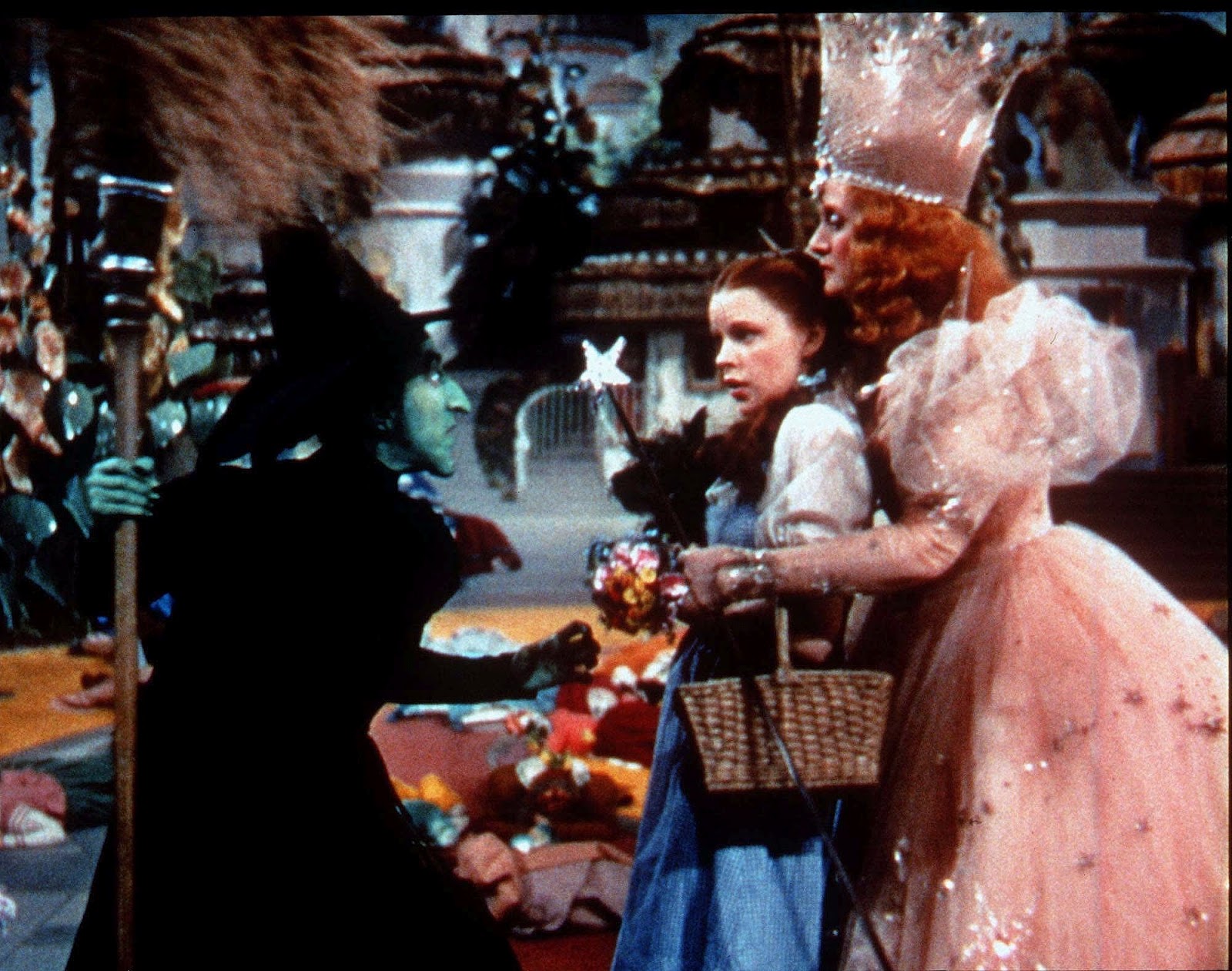
My Favorite Movies: The Wizard of Oz (1939)


What movie from any time or any place in the world has had a bigger impact on viewers than The Wizard of Oz? It is certainly the most seen and well-known motion picture ever made, endlessly parodied and referenced, with every single little thing that appears in the movie now a permanent part of American culture. One of its endearing qualities is its association with pretty much every person’s nostalgia attached to it. Most people see it when they are children and then always associate its images with their childhood. Even I, who was raised in a strict Baptist church that strongly protested letting parents show the movie to their children because of its depiction of “good witchcraft,” saw it at a young age. I know this because I remember having nightmares about the witch flying past my window.

I have seen The Wizard of Oz many times through the years, to the point that I have taken it for granted. Having just watched it for the first time in years, and for the first time as a real adult, I am only just realizing what an extraordinary force the movie is. It’s easy enough for grown-ups to laugh at all its goofiness, with the singing midgets and talking trees, but what would the movie’s fantasy world be without these charming moments of cute whimsy? It would be bleeding terrifying, that’s what.

Residing alongside all the cute characters and bright colors of Oz are, of course, the Wicked Witch and her flying monkeys. Margaret Hamilton’s evil sorceress is arguably the most famous element of the film, and she is a real scene-stealer, croaking and cackling the movie’s most famous lines (“I’ll get you my pretty, and your little dog, too!”) and building up to her messy demise. If children are scared of the movie, it’s probably because of her, and why shouldn’t they be? She threatens to kill the main character.

The film is also psychologically frightening. Even though it ultimately suggests that the entire fantasy section is a dream, consider the fact that the moral of the story is “there’s no place like home.” This refers to a real home with a real family. Note that Dorothy lives with her aunt and uncle who ignore her, and she loves her dog Toto so much as to suggest that it is her only “real” family. The idea that that family could be taken away from her is what makes her want to run away, and why she would dream that an evil witch has nothing better to do than threaten it.

Judy Garland as Dorothy is a warm and lovable performance and the movie wouldn’t have worked so well without her. Something most people seem to miss is how scared this little girl is. We all know that Garland was several years older than the character, but she brings such a timidity to the role that we believe it for every second. A wise-cracking Shirley Temple defiantly skipping through Oz would have been ridiculous and would have meant nothing. Judy Garland plays the part not far from the truth and, therefore, it rings even more true. Horror stories persist that the studio pumped her full of speed at the beginning of every shoot and followed it with a tranquilizer. The uncomfortable brassiere she had to wear to make her chest appear flatter also caused her physical harm, and none of it could have helped her eventual drug addiction and untimely death. What she got in return, whether she wanted it or not, was eternal stardom.

Although the movie’s story, message, content and psychological effect on all who see it have been the source of much careful study through the decades, the film was never meant to be analyzed. Its sole intention is to be a pleasing entertainment, which it continues to be. Although director Victor Fleming and his crew obviously had no idea they were making what would become the most beloved film ever, but they were surely anticipating success. MGM gave it the largest budget of any movie to date, which was topped the same year by their own Gone with the Wind.

The art design of The Wizard of Oz is one of its many pleasures, evoking a style most commonly associated with the stage, only bigger. I often hear complaints about how the sets and costumes look fake and silly and aren’t big and realistic enough. I also heard someone say once that a bigger yellow brick road would not have been a better one. One of the delights of watching this movie in our time of great technological advancements is being able to see a magical world that actually exists. No matter how much more expensive creating an Oz today would be, the 1939 one is still more real. It is my opinion that computers have stolen all the true charm of the movies for this reason. I suppose the only real complaint that could be raised about natural special effects is that they do sometimes go awry, like when Margaret Hamilton was severely burned during a fire mishap.

The Wizard of Oz is a prime example of cinematic imagination at its peak. Watching it seventy years after its release is a reminder of the wondrous things film is capable of, now that we’re living in an age where actually awe-inspiring movies are a rarity. That is this movie’s power. It sparks a feeling of innocence and amazement inside all of us that few other things can. To a certain extent, the movies couldn’t exist as they do without Dorothy, Toto, the witches, the monkeys, the Scarecrow, the Tin Man, the Cowardly Lion and the Great and Powerful himself. These are our nation’s symbols of childhood, and the best place I can think of to start discovering great movies. 

Wednesday, October 17, 2012

My Favorite Movies: The Night of the Hunter (1955)

The Night of the Hunter is one of the few films that has been firmly cemented into the critical consciousness without ever having been widely recognized by audiences. Anyone who sees it will never forget it, but so few people see it. It was a movie against type. It featured styles and techniques that were incredibly new alongside ones that dated back to the silent era. German expressionism, the style used in films like Nosferatu and The Cabinet of Dr. Caligari, was resurrected in an alarmingly Southern American setting. Most alarmingly, the film is decidedly unconventional, playing out in its own curious world with little care as to whether or not the audience is keeping up with it.

Charles Laughton had been one of the most successful British actors, starring in numerous popular American movies throughout the 30s and 40s. With The Night of the Hunter, he was giving directing a go for the first and only time. He had purchased the rights to a ridiculous novel of the same name and commissioned James Agee to write the screenplay. Reports say that Agee was in the darkest stages of drunkenness at the time and that Laughton changed much of the script himself. Agee died before the film was released.

The cast of the film is strange and varied. As two kids with a big secret, there are James Gleason and Evelyn Varden, who, quite frankly, are never altogether convincing as actors, but can perhaps be excused as children. Then there is Shelley Winters as the woman driven half-mad by the execution of her criminal husband and willing to give into the first seemingly good thing that comes along. Also giving what is oddly enough one of the finest performances of her career is Lillian Gish, former silent star who is more than praise-worthy in her sound appearance here.

Robert Mitchum was cast in the lead as a sinister preacher bent on seeking out a treasure hidden by one of his prison mates. Mitchum starred in this film at a point in time when he was still more or less a recognizable star, but had not appeared in a major Hollywood motion picture for years, having been more famously involved in a drug scandal. It is perhaps this history that makes his performance so believable. Harry Powell is a downright evil character and one that would have never worked without Mitchum behind it.

If the film had been made today, this character would not have been so exaggerated or so theatrical, probably toned down to a dismissible slasher. Powell is more than just a killer or a thief and cannot be described with any such narrow moniker. It is even debatable if he is crazy or not. Shown having actual conversations with God that usually concern the need to wipe out sin in ways God would not have actually approved, Powell seems to have created a loophole in Earthly morality. He considers himself above the logic of a world that would consider most of his actions wrong, because he is excusing them with divine authority he does not possess.

I think the fact alone that Powell is such a wicked character and a preacher is part of what makes the character so memorable. This film was released not long after the removal of the Hayes code which had previously limited Hollywood’s ability to put anything remotely offensive into their movies, including the appearance of a man of God who was anything less than pure. The most memorable thing about the character, though, is his speech about good and bad as demonstrated by the words “love” and “hate” that have been tattooed on either hand. There are a great many film fans who can quote this scene without faltering.

The most frightening thing about The Night of the Hunter is the bizarre world it creates. It does not take place in reality, but in a sort of dream. It is said that it was always the intention that the film create what would be perceived as a children’s nightmare and many images support this. The first time Harry Powell turns up anywhere near the children is when his shadow is very suddenly cast onto the wall of their room. He stands outside their house ominously singing the hymn “Leaning on the Everlasting Arms.”

I actually find it a bit strange that nobody ever really comments on the fact that this movie features children in genuine danger. This was certainly uncommon for its time and remains so today. The scene where Powell chases the children is really quite horrifying. They escape his grasp in a makeshift boat, but only barely. Another iconic image is that of the children sleeping in someone’s barn as Reverend Powell is riding a horse past them in the distance. The boy looks on in awe and asks a good question: “Don’t he ever sleep?” Monsters seldom do.

There seems to be some debate in the critical world as to whether or not the ending is appropriate. Not to spoil anything, but the movie does conclude cheerfully. Brother Love conquers Brother Hate, partly with the help of the Lillian Gish character. I think the scene in which Gish, gun in tow, defiantly sings back at Powell is one of the most chilling in the film, but because it is so triumphant. Others don’t see how a Sunday school lesson is the right climax to a horror story, but they are missing the point. The film’s intention is not only to terrify us, but mainly to inspire. Can you imagine how cruel it would have been to end the film the only other possible way?

When it was released back in 1955, nobody liked it. It was far too unusual and different. Audiences and critics alike had no idea what to do with it, and it sank into obscurity. Many years later, it received a renewal of interest, and is now often referred to as one of the greatest movies ever made. Despite this, it is a still relatively unknown picture. Perhaps if audiences had realized how great it was sooner, Laughton would have made other masterpieces. Instead, he cut himself off from the industry almost entirely and died seven years later. Thankfully, his brilliant, haunting, and only work has been well preserved through the years and can be enjoyed regularly by those who know it.